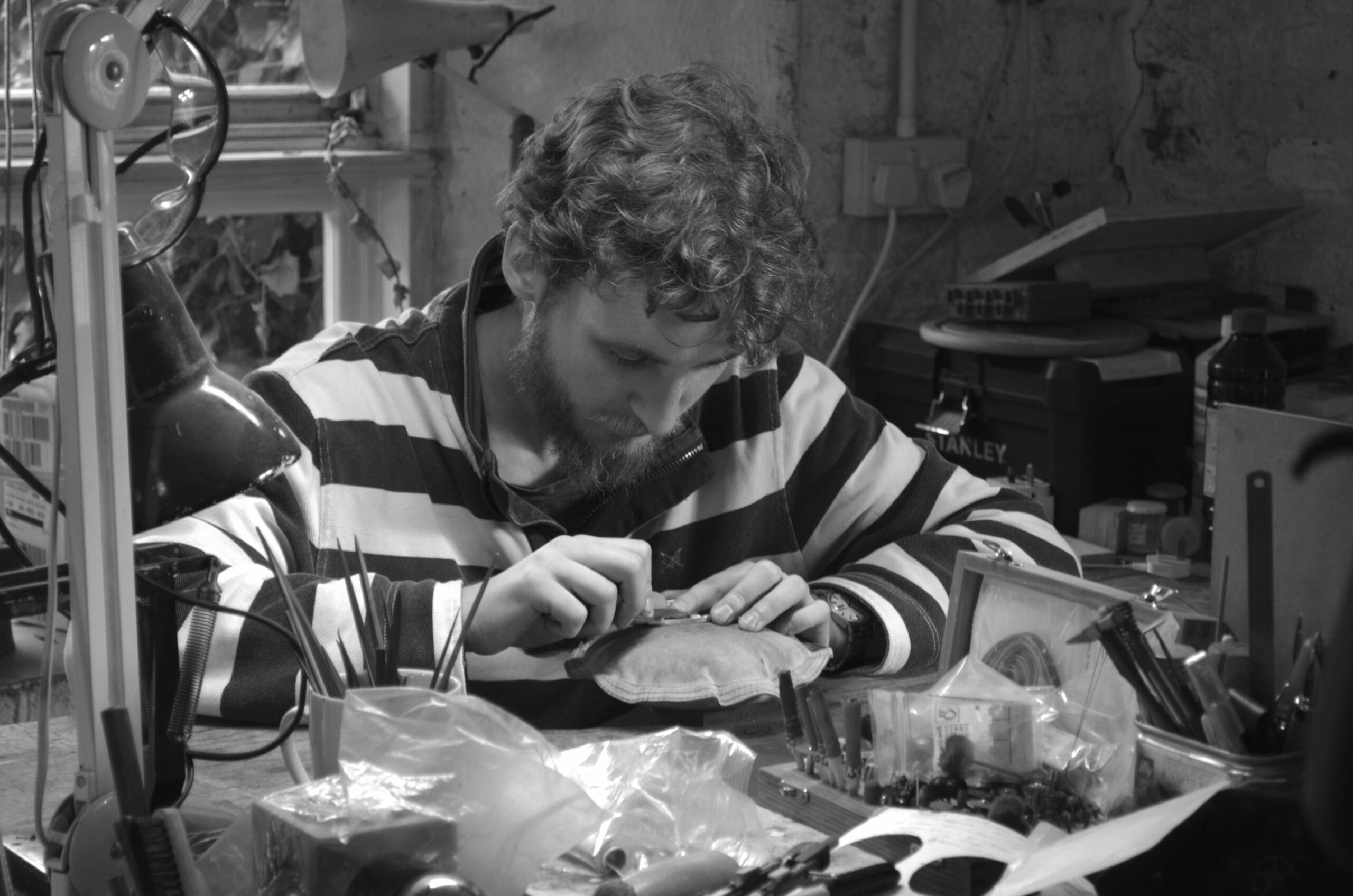
An artist who can count some of the world’s best musicians as his customers, has won the 2024 Hand Engravers Associations Christmas Card competition, sponsored by Baddeley Brothers.
When John Cook discovered he was dyslexic, he used his hands to express himself. At school, he excelled in crafts such as woodwork and metalwork, and when he left at 16, he went straight into a ‘hands-on’ role in the tool room at Ford in Dagenham.
Incredulous that he was getting paid to make things with his hands, he quickly moved up the career ladder.
A machine builder in Detroit, Michigan, headhunted him and says this is where things turned interesting.
Musical interlude
He tells us: “I was playing saxophone in various bands in the 1980s and had designed a saxophone stand in my spare time. After being laid off from the American company, I made the decision to pursue making saxophone stands as my full-time occupation.
“I set up a manufacturing business called SAXRAX stands. I made stands for the sax players in The BB King Blues Band, Jools Holland, Alicia Keys, Prince, and Stevie Wonder, to name but a few. This business gave me enough money to open my music shop, where I sold and repaired instruments.
“Although I have only been engraving for a short period of time, I have actually made things with my hands for over 45 years . So the transition to engraving was, for me, never from a standing start. I took to it like a duck to water.
Ninety percent inspiration
“The easy bit is the engraving. The hardest bit is what to engrave. You can learn to engrave, i.e. how to move the tool, but what to engrave can take a lifetime.
John says he spends around 90% of his time painting, drawing, and studying portraiture and landscapes, and only 10% engraving.
“Most people who want to learn to engrave just want to cut the metal and use the tools. But in truth, you should study art first. Build hand skills and then engrave. “
John said he was ‘over the moon’ when he heard he had won the Christmas card competition. But he said his joy wasn’t for the glory of winning.
“At my age, winning things is not that important. The good thing is that if people read my story, I hope it will encourage others to take up engraving.
Engraving is a hobby
“Most things you see and read about are of young engravers that go to study engraving from college or apprenticeships. I started life in a factory, had a burning desire to create art, and found a convoluted journey into engraving after 50 years and now do it as a hobby in my retirement.
“It’s a great hobby for any age. It doesn’t need to be about earning money. Just do it for the love of it. I want to show people through my story that people should give it a go.
“The greatest prize for me and the reason I entered was to be able to go to Baddeley Brothers and spend a day with the people there. I love factories. I grew up in them and feel at home in them. I loved talking to Charles and John, the machine operator. This is the greatest prize for me. I share their love of making things. It’s a passion that has never left me.”
He also enjoyed seeing his design come to life: “I was amazed at the passion that Charles and his colleagues put into my print. This was something to see. Their commitment to making the best print they could was very humbling. I take my hat off to the team at Baddeley Brothers. The card looks great. Better than I had expected. But then again, Charles and his team were always going to make this something special.
“He pushed me in a good way to look at making a two colour plate and an embossing plate. This was fascinating, and now I’m totally into Victorian illustrations, all that’s down to Charles.”
Searching the archives
Commercial director Charles added: “John is clearly a very capable machinist, but he also has the wonderful ability to appreciate art and apply it to a copperplate. His excitement had me searching through our archive boxes for anything related to the Victorian era. Thankfully, I could satisfy his appetite by showing him some of our stunning plate designs from the late 1800s and early 1900s. During our research for our book in 2015, we stumbled upon these from our old catalogues held at St Bride Library.
“For the first time in four years of the competition, we worked with multiple plates. Three on this occasion: gold, red and emboss. Using the bulino style, John meticulously hand-engraved each one to ensure proper registration. Unbelievable level of skill, which we keen to promote.”
In recent years, John studied hand engraving under Beppe Casale. He added: “Living in Italy and engraving full time was an amazing experience. I now do a lot of engraving for printing. I’m a member of the East London Printmakers . I have an exhibition in November ’24 in Mile End, exhibiting some of my prints. In January, I returned to Las Vegas to attend the engraving convention. This time, I was a participant and sold my prints . At the time of writing this, I am in Nashville attending an engraving convention teaching engraving to print.
Chance encounter
Asked how he got into engraving, he said it was a chance encounter with an exhibition that happened to be in the hotel where he was staying.
“I was making saxophone stands and attended the biggest music trade fair in the world called NAMM in LA USA. I had a booth there. When the trade fair finished, I hired a car and drove to Las Vegas for a few days. I booked into a hotel and in the same hotel there was an engraving convention. I wandered in and saw engraving for the first time. I was hooked.
“When I got home, I did some investigating and booked myself on a hand engraving course with the Hand Engravers Association. This was 2018. I had a music shop, but when Covid hit, I had to shut, and I just sat and engraved on my own.
“I found it challenging at first, but also found it very natural. I found that I was good at it. And found something that combined all of my previous skills and passions into an art form. The metalwork side, art, and hand skills. “