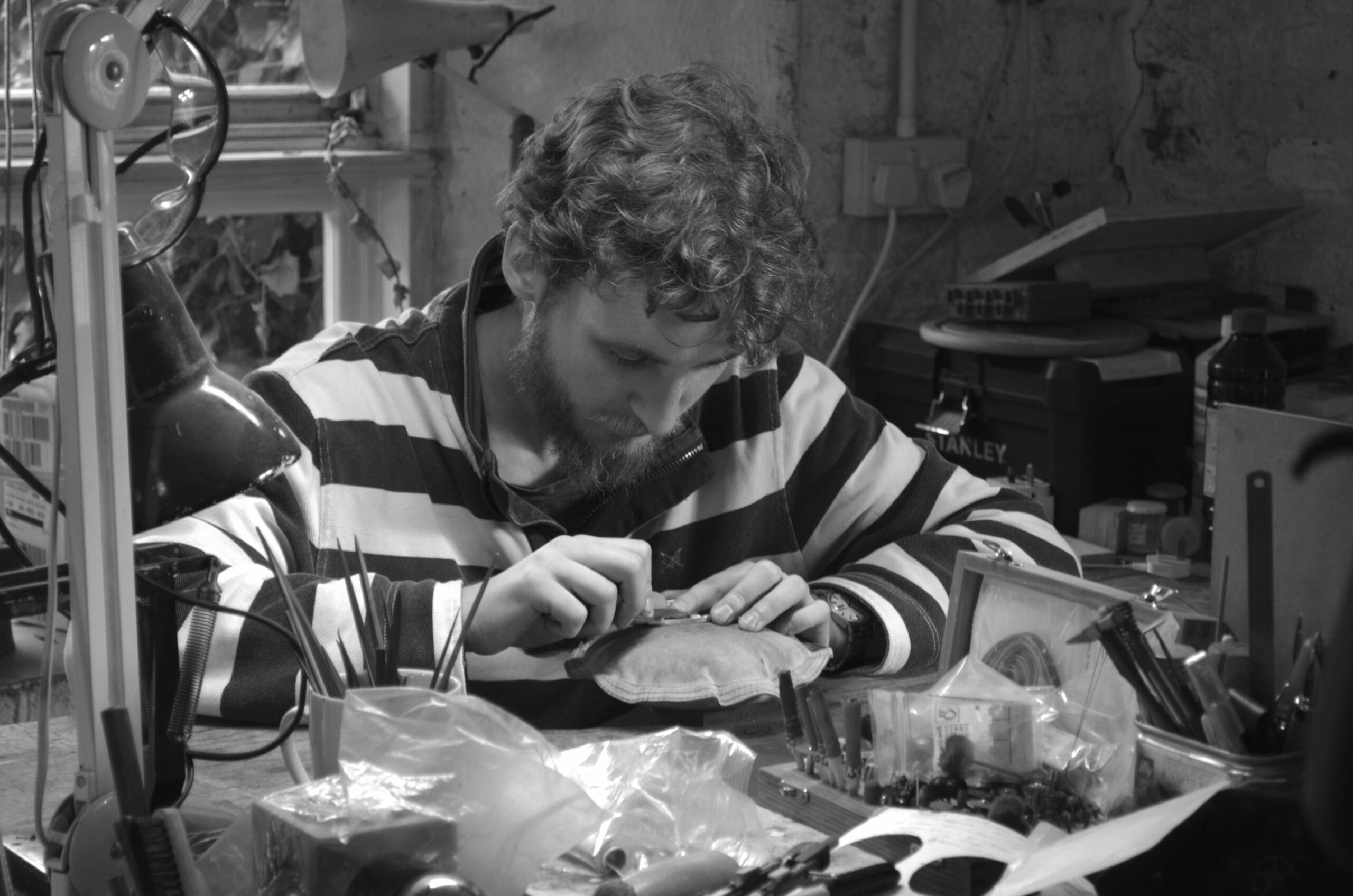
Engraving, a skill so rare that there was recently only a handful of artisans left. But with an increase in workshops and competitions, this ancient craft of copperplate engraving is back in the limelight.
And now with support from the specialist printer Baddeley Brothers, one such competition winner will see his engraving of Santa Claus go into production as Christmas Cards.
Andy Beavan-Smith’s work caught the eye of the Hand Engravers Association in their recent contest, and depicts Santa in his workshop, ironically carving a copper plate.
Finding skilled craftspeople is difficult, which is why Baddeley Brothers support the Hand Engravers Association, a non-profit organisation dedicated to preserving and promoting the ancient craft skill of hand engraving.
A niche skill
Both organisations are keen to keep alive the skill of copperplate printing. Sally Dodson, Association Manager at the Hand Engravers Association, explained that “Copperplate engraving is a niche skill; a specialism within a specialism! Three years ago, we only knew of one or two professional engravers active in copperplate engraving.
With thanks to the enthusiasm of silversmith and engraver Angus McFadyen and the support of the Goldsmiths’ Centre, we could organise copperplate engraving workshops. This brought us to the attention of Baddeley Brothers and it was not long before we realised our shared passion for supporting heritage crafts and the competition idea took shape.”
Copperplate printing, also known as engraved printing, uses a polished copper plate on which a design is etched or engraved. The fine handwriting that is associated with 18th and 19th-century copperplate engravings is often referred to as copperplate. Engraving is the “pre-press” part of the process. The engraved plate, or die, is then placed in the die-stamping press.
Dating from the 16th century, copperplate printing or engraving still creates an image of elegance and distinction. It allows designers to create a higher quality of printed materials than etching or laser cutting might achieve. The technicians at Baddeley Brothers have been practising the art of this type of printing since the 19th Century.
Hand engraving captures the nuances of design

To create a copperplate print, the image is firstly engraved onto a plate. Nowadays, this is often achieved through computer typesetting, but for the highest standards of print, hand engraving is still employed to capture fine detail and nuances of a design. The plate is then inked and stamped against a sheet of paper at pressures of up to two tons per square inch, causing the image to be transferred to the paper stock.
The extreme force used in the die-stamping presses the paper deep into the engraved areas of the printing plate, creating an impression on the paper surface. It is this impression that imparts the finished image with its unique, three-dimensional character and tremendous tactile appeal. In addition, because the inks are opaque, they produce crisp, well-defined images in colours that are exceptionally deep and true. The opacity allows the engraving of light-coloured images on darker paper stocks.
Engravers that specialise in copperplate engraving are extremely scarce. Baddeley Brothers and the Hand Engravers Association introduced the greeting card competition to inspire more engravers to try copperplate engraving and the results have been . . . extremely encouraging! The Directors of Baddeley Brothers selected the winner at the Association’s Festival of Engraving, on Sunday 12 September 2021. It was difficult to choose just one, and Special Commendations went to Anna Olafsson and Sheila McDonald for their unique, beautiful and stylish interpretations of the design brief.

Anna Olafsson
Runner-up engraver and printmaker Anna Olafsson explained that: “I was inspired by Bernini’s wind rose design in St Peter’s Square, medieval images of trumpeting heralds and Aubrey Beardsley’s black and white designs.
I used these inspirations to create an image of a musician/herald blowing the winds and stars from trumpets to mark the New Year.”
Sheila McDonald
Sheila McDonald “Poinsettia” greeting card design 2021 and detail from “Alstroemeria” engraved copper plate 2021.

Runner-up jeweller, enameller and engraver Sheila McDonald explained: “I love drawing flowers and plants. Poinsettia is synonymous with the Festive season.
“With engraving, I love the idea that the prints can be hand coloured, as I did with prints taken from the plate I engraved with an Alstroemeria design.”
Andy Beaven-Smith
The winner, engraver Andy Beaven-Smith, described his design process: “When I was thinking of ideas for the greeting card competition, I wanted to choose a design that engravers and associated trades would appreciate along with non-engravers.
“Santa’s workshop was a design I thought would show the fine detail that is achievable by printing from an engraved copper plate. So why not have Santa engraving in his workshop?
“I drew a sketch on paper for layout and prospective purposes then transferred the design and hand-cut it into the copperplate. I am quite happy with the end result and after attending the Association’s copperplate printing workshops in Manchester believe this will print nicely to show the fine details.”
Andy will visit the Baddeley Brothers workshop in October to see the card go into print production. His Instagram account is #incisedmetaland.
“Andy’s work really appealed to us. It was fun, topical and because he’s skilfully engraved the plate in reverse, it was ready to go on press straight away,” commented Baddeley Brothers director, Charles Pertwee.
The Hand Engravers Association is registered with the Charity Commission as Charitable Incorporated Organisation number 1175879 www.handengravers.org.uk